
Life in Sumter County looks different on four wheels these days. Drive through The Villages, Bushnell, Wildwood, or Webster, and you’ll see more Hyundai Ioniqs, Chevy Bolts, Teslas, and Ford Mach-Es parked in carports than even two years ago. Retirees and working families alike are switching, and the next question they all ask is the same one: how do I charge this thing at home? That’s where dependable EV charging station services in Sumter County come in, and where the crew at Altech Electric of Central Florida, Inc has helped plenty of local drivers get sorted.
So what does a real install involve? It’s not just bolting a charger to the wall. A safe, code-compliant setup means checking your panel’s spare capacity, sizing the breaker correctly, picking the right wire gauge for the run, and pulling a permit through the county. In this guide, we’ll walk you through your charger options, what the install actually looks like step by step, what shapes the final cost, and how to spot an electrician who knows EV work from one who’s bluffing. By the end, you’ll feel ready to ask the right questions before signing any quote.
Why more Sumter County homes are adding their own chargers
People are no longer driving in the same way they used to. With all of the golf-cart culture in The Villages, the daily commutes to Ocala, Leesburg, and Orlando, and the rural stretches from Coleman to Lake Panasoffkee, public charging here is still hit-or-miss. This is one of the main reasons home setups exploded. Why spend time waiting in a station if your driveway can do the job overnight?
Next there’s the cost of driving angle. According to calculations from the US According to the Department of Energy’s Alternative Fuels Data Center (2024), the average American household saves between $800 and $1,000 annually on fuel switching from gasoline to home-charged electric driving. For those on fixed budgets in Sumter County, that math matters. Trustworthy EV charging station facilities in Sumter County modify that saving from being a theoretical benefit right into a daily routine.
Reselling is another reason. You can now search for homes with a Level 2 charger installed in Florida’s MLS and real estate services. Therefore, if you plan to put your property up for sale, an installation will often pay you back in buyer attention.
Charger choices, amperage, and their suitability for every home.
The type of charger you need depends on your vehicle, your daily mileage and at home electric capacity. If you get the match of a power supply wrong, you find that either you charge too slowly or you overload an aging panel. Electric vehicle charger installation services in Sumter County start with this conversation – not a sales pitch for the most expensive unit.
A level 1 charging is plugged into a standard 120-volt outlet which can add 3 to 5 miles of range hourly. A good option for a plug-in hybrid or a short-range driver. Level 2 charging occurs at a voltage of 240 volts. It can add 25 to 40 miles per hour of charge, which is practically all full EV drivers. Hardwired Level 2 units are less likely to be damaged by Florida humidity outdoors and can handle higher amperage than plug-in versions. DC fast chargers are available but aren’t common in residential areas because of the heavy three-phase power they need.
Choosing the right brand is also important. The ChargePoint Home Flex, Wallbox Pulsar Plus, JuiceBox 40, Tesla Universal Wall Connector and Emporia EV have strong local presence. Hardwired units of 48 amps in the residential projects mostly get installed in Sumter and Lake counties lately, said a licensed master electrician working throughout Central Florida.
| Charger Option | Charging Speed | Suits | Install Difficulty |
| Level 1 (120V outlet) | 3–5 mi/hour | Plug-in hybrids, low daily mileage | Very easy, no new circuit |
| Level 2 Plug-In (240V) | 20–30 mi/hour | Daily EV drivers, moderate use | Moderate, NEMA 14-50 outlet |
| Level 2 Hardwired (240V) | 30–40 mi/hour | Long commutes, dual-EV homes | Higher, dedicated circuit |
| Smart Bidirectional (V2H) | 30+ mi/hour | Newer EVs, backup power needs | High, advanced wiring |
What a proper install actually looks like
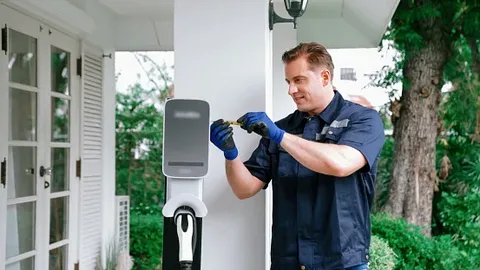
A clean install runs in a fixed order, and any electrician who skips steps is cutting corners that come back to bite you. Professional EV charging station services in Sumter County cover every stage from first measurement to final handover. Want to know what to expect on install day?
The first move is a load calculation on your existing panel. Many older homes in Bushnell, Center Hill, and Sumterville run on 100-amp service, which struggles with a 50-amp charger plus the central air, well pump, and pool equipment. If that’s your situation, a service upgrade to 200 amps comes first. After the load check, your electrician pulls a permit through the Sumter County Building Services Department, which is required under the 2023 Florida Building Code for any new 240-volt branch circuit.
After permitting, the physical work begins. Conduit runs from your panel to the charger location, a dedicated double-pole breaker drops into the panel, the charger mounts to the wall, and the wiring connects on both ends. Then the county inspector visits to verify everything meets code. Final commissioning includes pairing the charger to its app, testing amperage delivery, and setting off-peak charging schedules with Duke Energy or Sumter Electric Cooperative, whichever serves your address.
What shapes the final price of your install
Pricing swings more than first-time buyers expect, and the charger itself is rarely the biggest line item. Trusted electric vehicle charger installation services in Sumter County will walk you through every cost driver before they hand you a quote. So what should you watch for?
Panel age and electrical upgrades
Older homes around Webster, Lake Panasoffkee, and the rural stretches of Sumter County sometimes run on 1980s panels with FPE or Zinsco breakers. These are flagged as fire risks and need replacement before any new circuit goes in. A 200-amp service upgrade adds labor, materials, a separate permit, and often a utility coordination call.
Distance and conduit complexity
A short run inside an attached garage is straightforward. Running conduit across an attic, through a finished wall, or out to a detached garage or carport multiplies labor hours fast. Longer runs also need thicker wire to handle voltage drop in Florida heat. According to the Edison Electric Institute (2023), residential EV charger install costs across the Southeast vary widely based on these two factors alone.
Permit fees, charger brand, hardwired versus plug-in mounting, and any drywall patching after conduit work also feed into the total. A transparent contractor itemizes each piece on the written estimate so you see where every dollar goes.
How to pick the right local electrician
Choosing the right installer is more important than choosing a trendy charger. A faulty installation poses fire risks, goes against manufacturer warranty, and means tearing up the work and doing it again within the year. How can you differentiate between an actual EV specialist and a regular electrician who completes two or three jobs on the weekend?
Begin with state licensing. In Florida, every electrical contractor is required to have an active certification from the Department of Business and Professional Regulation. Before signing any document, consult their site to check the license number. Inquire about the total number of residential EV chargers the company has installed in the past year. It is crucial to get the volume right as the EV work involves load calculations, smart-charger commissioning, and utility coordination for which the occasional installer rarely practices.
A contractor who does residential EV charging station work in Sumter County week in and week out, like Altech Electric of Central Florida, Inc, will already know the local permit process through Sumter County Building Services, know which charger brands can handle our heat and humidity, and have the equipment-specific liability insurance handymen often skip.
After learning what signals to observe, you can quickly identify red flags. If you receive a vague written quotation, no mention of permits, refusal to perform a load calculation, request for a large upfront deposit over 25%, and pressure not to inspect – get out! You will receive itemized estimates and permit timelines, as well as post-install documentation for record-keeping and warranty purposes, when you use reliable EV charging station services in Sumter County.
Conclusion
Adding a home charger is one of the smartest little upgrades that an EV owner in Sumter County can make. Your battery is charged to the max you skip the public stations, and you’ve added something that many future buyers are now looking for on the listings. Now, from load calculations and panel work to permits and final commissioning, a proper install touches more than just the garage wall, and the right electrician makes the difference between a clean job and a callback.
Once you’re ready, contact Altech Electric of Central Florida, Inc for a no-obligation to buy in-home estimate. We will take a look at your panel, go through the charging options that complement your driving, and provide you with a no-obligation detailed proposal of what we will do and when we will do it. Absolutely no pressure and no upselling. We’ll give you simple and straightforward answers so you can charge at home with confidence.
FAQ’s
What is the time duration of Level 2 charger installation?
Most home installations take four to six hours to complete after the permit gets approved. When panel upgrades or long conduit runs are performed, the work can take a full day or two. Scheduling the county inspection will add a couple of business days for final sign-off and activation.
Do I need a permit for EV charging station services in Sumter County, Florida?
yep The 2023 Florida Building Code mandates permits for any new 240-volt branch circuit.” That includes Level 2 chargers. Your licensed electrician must get the permit through Sumter County Building Services and schedule the inspection once the install is complete.
Will wall-mounted chargers endure the Florida humidity and heat?
Level 2 outdoor rating units featuring NEMA 4 and NEMA 4X enclosures perform well in Florida. By parking your vehicle under a covered carport or inside a garage, you can even further extend its lifespan. Over the years, exposure to the sun and rain can start degrading plastic housings on cheaper models.
What impacts the overall installation cost of an electric vehicle charger in Sumter County?
The ultimate figure depends on factors like panel capacity, distance from panel to mounting location, wire gauge, permit fees as well as charger brand. The cost to upgrade a home’s service from 100 to 200 amps is more than new homes with a 200-amp panel already in place.
Can any electrician perform residential EV charging station services in Sumter County?
While any licensed electrical contractor can perform the work, experience with EVs is important. Electrical engineers perform load calculations, commissioning, and utility coordination weekly. This minimizes installation mistakes and warranty complications compared with electricians who rarely touch anything EV-related.
Most home installations take four to six hours to complete after the permit gets approved. When panel upgrades or long conduit runs are performed, the work can take a full day or two. Scheduling the county inspection will add a couple of business days for final sign-off and activation.
yep The 2023 Florida Building Code mandates permits for any new 240-volt branch circuit.” That includes Level 2 chargers. Your licensed electrician must get the permit through Sumter County Building Services and schedule the inspection once the install is complete.
Level 2 outdoor rating units featuring NEMA 4 and NEMA 4X enclosures perform well in Florida. By parking your vehicle under a covered carport or inside a garage, you can even further extend its lifespan. Over the years, exposure to the sun and rain can start degrading plastic housings on cheaper models.
The ultimate figure depends on factors like panel capacity, distance from panel to mounting location, wire gauge, permit fees as well as charger brand. The cost to upgrade a home’s service from 100 to 200 amps is more than new homes with a 200-amp panel already in place.
While any licensed electrical contractor can perform the work, experience with EVs is important. Electrical engineers perform load calculations, commissioning, and utility coordination weekly. This minimizes installation mistakes and warranty complications compared with electricians who rarely touch anything EV-related.